Symantec Norton SystemWorks 2005 - $19.9
Simply pushing harder within the old boundaries will not do.
Alimony is like buying oats for a dead horse.
Generally speaking, the Way of the warrior is resolute acceptance of death.
Life is made up of marble and mud.
God heals, and the doctor takes the fee.
The past is a foreign country; they do things differently there.
The guilty catch themselves.
Wednesday, November 30, 2005
Well, Marble, Mud, And a Few Trace Elements Like Sodium and Phosphorus
The few spam mails that get through the filter on my email account are some of the most zen things I see on any given day...

Tuesday, November 29, 2005
Widening the Circle
The more perceptive of you will note the creation of the "Hermeneutic Blog Circle." It came about, initially, because I kept having to go to my blog and then click links from there to read blogs that are more than one degree of separation outside my immediate realm of blogging friends. Then there was some notion about the cyber-birthing of intellectual communities based on (un)common interests and blah blah post-modern blah, but I quickly became bored of all that.
It supposedly lists by most recently updated, and will display a friendly "new!" message if you have updated your blog in the last 12 hours (though so far I've only verified that it works for my own blog. Your mileage may vary). If for any reason whatsoever (e.g. you have a lack of coolness in your life, or some such thing) you wish to join the Hermeneutic Blog Circle, the code to add it into your style-sheets or whatever appears below:
<script language="javascript"
type="text/javascript" src="http://rpc.blogrolling.com/display.php?r=d17f0c3848870645e948b6cd3e2822a0">
</script>
The content is, presently, entirely under my control. My editorial filter is well known to be a dictorial and unyielding one, but if you are feeling that your blog is unloved, leave me a message and I'll add you to the little virtual circle, if indeed I have even a vague idea who you are.
As you were.
It supposedly lists by most recently updated, and will display a friendly "new!" message if you have updated your blog in the last 12 hours (though so far I've only verified that it works for my own blog. Your mileage may vary). If for any reason whatsoever (e.g. you have a lack of coolness in your life, or some such thing) you wish to join the Hermeneutic Blog Circle, the code to add it into your style-sheets or whatever appears below:
<script language="javascript"
type="text/javascript" src="http://rpc.blogrolling.com/display.php?r=d17f0c3848870645e948b6cd3e2822a0">
</script>
The content is, presently, entirely under my control. My editorial filter is well known to be a dictorial and unyielding one, but if you are feeling that your blog is unloved, leave me a message and I'll add you to the little virtual circle, if indeed I have even a vague idea who you are.
As you were.
Friday, November 25, 2005
Nothing Ever Changes, But Nothing Stays The Same
It's the day after Our First Thanksgiving in the New House™; today the friends and family are off shopping and gadding about (while I have elected to stay home, not that I don't love shopping malls the day after Thanksgiving...oh, no wait, I don't. I loathe them). It's Thanksgiving, and suddenly we live in house that looks like a house (instead of a vast recepticle of moving boxes), we have friends and family that come over and eat lots of food and drink wine and everything seems pretty okay again.* I've posted a few photos above; we had some exceedingly good squash in both soup and crepe form, and our friends Ryan and Alicia brought an entire carnivorous meal to go with our vegetarian fare. We ate a lot of food. Then we sat in the living room in a sort of mass food coma for about three hours. It was goooooooood.
At ten o'clock that night, there was a knock on our door. On our porch was standing a guy who could barely stand still, smelling of something smokey that I didn't recognize, telling me a desperate story about how his car was about to be towed and could I just give him a couple of bucks because his wallet was in the car, but he couldn't get it, and he would get it and pay me right back. I wasn't really sure what the right thing to do was. It didn't seem like I could really do him any favors either way. I gave him some money and he left. I don't know what I'll do the next time that happens.
It was the ten billionth Thanksgiving hosted by the newly married couple in their new house (oh look, it's 1952. Though I guess the crack addict having withdrawal was less than Eisenhower-y) in the history of mankind, and I don't know that the fact that I'm publishing the news and pictures about it on the web where people in China could (entirely theoretically) access it until the end of either time or digital computing, whichever comes first, makes it profoundly different from all those Thanksgivings celebrated by the poor sods who lived in the dark ages before wireless broadband. On the other hand, this one was different. This one was ours. One of my commonly-cited corollaries to Odds-Are-Oneness is that It's Different When It's You. All of the things, the problems, the joys, the sorrows, and the rites of whatever have been experienced and chronicled infinite times, but never by You. Wherever You are, somebody else has already been, and can tell you all about it. But it won't ever be quite the same, because that happened to Them. This is happening to You.
I'm not sure what the enlightened position on this is--I suppose if you're totally on board with the Sattvah, or whatever, there's no difference between Them and You: you've achieved totally empathy. That's what I hear, anyway. For the rest of us, I'm not sure what Right Action is. In the small things, like Thanksgiving, it seems okay to tell the stories and show the pictures. If You tell the story poorly, They will be bored for ten minutes, and if You tell the story well, They might be enthralled, and remember how it was when They had the same experience. Either way, no permanent scarring. As for the harder questions, I don't know.
*after seeming like our real estate experience couldn't possibly get any worse, this week it went ahead and got worse, which is what the trying-to-be-a-Buddhist entry below is about. I would talk about it, but it's too terrible. I want it to be done and to never speak of such things again. As L. says, we are never ever moving again. Ever.

At ten o'clock that night, there was a knock on our door. On our porch was standing a guy who could barely stand still, smelling of something smokey that I didn't recognize, telling me a desperate story about how his car was about to be towed and could I just give him a couple of bucks because his wallet was in the car, but he couldn't get it, and he would get it and pay me right back. I wasn't really sure what the right thing to do was. It didn't seem like I could really do him any favors either way. I gave him some money and he left. I don't know what I'll do the next time that happens.
It was the ten billionth Thanksgiving hosted by the newly married couple in their new house (oh look, it's 1952. Though I guess the crack addict having withdrawal was less than Eisenhower-y) in the history of mankind, and I don't know that the fact that I'm publishing the news and pictures about it on the web where people in China could (entirely theoretically) access it until the end of either time or digital computing, whichever comes first, makes it profoundly different from all those Thanksgivings celebrated by the poor sods who lived in the dark ages before wireless broadband. On the other hand, this one was different. This one was ours. One of my commonly-cited corollaries to Odds-Are-Oneness is that It's Different When It's You. All of the things, the problems, the joys, the sorrows, and the rites of whatever have been experienced and chronicled infinite times, but never by You. Wherever You are, somebody else has already been, and can tell you all about it. But it won't ever be quite the same, because that happened to Them. This is happening to You.
I'm not sure what the enlightened position on this is--I suppose if you're totally on board with the Sattvah, or whatever, there's no difference between Them and You: you've achieved totally empathy. That's what I hear, anyway. For the rest of us, I'm not sure what Right Action is. In the small things, like Thanksgiving, it seems okay to tell the stories and show the pictures. If You tell the story poorly, They will be bored for ten minutes, and if You tell the story well, They might be enthralled, and remember how it was when They had the same experience. Either way, no permanent scarring. As for the harder questions, I don't know.
*after seeming like our real estate experience couldn't possibly get any worse, this week it went ahead and got worse, which is what the trying-to-be-a-Buddhist entry below is about. I would talk about it, but it's too terrible. I want it to be done and to never speak of such things again. As L. says, we are never ever moving again. Ever.
Tuesday, November 22, 2005
Stuff
The Buddha says, attachment to material things is the source of all suffering. Somebody, somewhere, seems bound and determined for me to learn this lesson. And to learn it today, in particular.
On the minus side, dealing in real estate is not our friend.
On the plus side, when you are moving the large heavy objects to which you sometimes experience attachment, it is nice to have friends.
Also, it is nice to be married to someone who does not react to things going badly by getting mad at me, and I cannot imagine what it would be like to go through such an experience with houses and buying and selling as we have were this not the case. So, L., thanks and love. And that, folks, is as Buddhist as I can be right now.
On the minus side, dealing in real estate is not our friend.
On the plus side, when you are moving the large heavy objects to which you sometimes experience attachment, it is nice to have friends.
Also, it is nice to be married to someone who does not react to things going badly by getting mad at me, and I cannot imagine what it would be like to go through such an experience with houses and buying and selling as we have were this not the case. So, L., thanks and love. And that, folks, is as Buddhist as I can be right now.
Saturday, November 19, 2005
The Role of Calvino Will Be Played By Sam for Tonight's Performance
This post started as a comment on Sam's last post on the ongoing dialog about the Doomsday Argument (see below), but then it became hopelessly too long for a comment. If you are coming late to this argument...um, move on to something else more interesting (This must be what it is like if you're, e.g. dailykos versus drudge report, or whatever. Endless co-mingled threads that eventually manage to lose absolutely everybody. What fun).
Sam: I still think that Bayes tells (you) nothing about (you) being an American, until after he has found out his IS American, at which point Bayes and (you) agree, in that the latter says 'the odds are one' and the former says, 'we do not have a random sample any longer, so my logic does not apply'. Also, by the way, SEGA! iPOD NANO! RAGE!
The Stoat: Indeed, and perhaps I have previously said Bayes, author of the probability theory, where I meant Leslie, who is the author of the Doomsday Argument. Sorry about that.
Sam: I see. So we agree that the Doomsday Argument is wrong, and that it's because Bayes' Theory does not apply. Then what is your quibble?
The Stoat:My quibble is perhaps really only semantic, but it's that trying to attack the Doomsday Argument by figuring out whether you are a random sample of all of humanity is the path of madness. It seems hung up in problems of temporality, which Leslie tries to overcome with this idea of "Doom Early" (a bag with a few marbles) versus "Doom Late" (a bag with many, many marbles). Much argumentative reasoning ensues. My point is that it is for naught. Leslie is unlikely to be convinced, and you are unlikely to be convinced by Leslie, and I think it's because randomness doesn't enter into it. My argument is that deciding whether you are a random human is logically equivalent to asking "What are the odds that I would be born at the time I was actually born?" The question has meaning, but it is not about statistics or randomness, because you were actually born at that time, it has already happened. It's an Odds Are One™ question (I'm totally going to trademark this and then the residuals are going to start pouring in).
Sam: What does this have to do with Bayes' Theorem?
The Stoat: Nothing. My argument is that not that it doesn't apply because you're not a random human, my argument is that probability does not apply at all because you are already you, stating the argument.
Sam: I have completely, totally and utterly lost you.
The Stoat: Here is the argument I thought of on the walk to work this morning. Either this will help, or I should abandon this line of reasoning forever. The argument begins now. *Ahem*. One of the (many) things we gloss over in the Doomsday Argument is the idea that there is a discrete first human (or for that matter a discrete last one). Unless we are Creationists, we wouldn't argue this, but we are assuming that it doesn't matter too much. Anyway, assume you believe in evolution.
Sam: You may make that assumption.
The Stoat: Then, you, Sam, for the sake of argument the current person considering the Doomsday Argument, cannot trace your lineage back to a distinct first human. Nor can anyone. The so called "bag" containing all of humanity, even as a species, cannot be traced back to a distinct Homo Sapien #1.
Sam: Yes, I agree. But I don't see how it's a problem that the line is a little bit fuzzy between Homo Sapien and Homo Erectus, or whomever.
The Stoat: So if it's not, is it okay if our "bag" contains some Homo Erecti, or some thousands to million of years of transitional species, just to make sure we get everybody who might possibly be considered Homo Sapien #1?
Sam: No, no, I see where you're going with this. I'm going to get on a slippery slope wherein we wind up having to trace the human lineage back to amoebas or something when in fact I could never have been born as an amoeba.
The Stoat: Indeed, the odds of Sam being born an amoeba are zero, For You Are Sam.
Sam: For I Am Sam.
The Stoat: Anyway, that's not quite where I'm going with this. My proposal is that including subjects in your metaphysical grab bag, such as homo erecti or amoebas as whom you have no chance of being born invalidates the terms of the experiment.
Sam: I want to believe you, but I don't quite see that as a problem. Nor do I see that it can't be solved by starting a couple thousand years into the advent of Homo Sapiens and numbering one of them human number one, just to be safe.
The Stoat: I'll grant you the latter thing, because I don't actually need it to make my argument. What I need is the former thing. Recall why the Doomsday Argument actually seems to work: You have a bag labeled "All Humans For All Time," and you know that this bag has two possible identities: Doom Early, meaning that there are 70 billion total humans in the bag, and Doom Late, in which there are many trillion humans in the bag. You reach into the all-humans-for-all-time grab bag and pull out a human--it happens to be you, and you have a number affixed to you that's your birth order, and it is under 70 billion, you apply Bayes theorem, blah blah blah.
Sam: (makes the "blah blah blah" hand motion)
The Stoat: There's all that confusion about whether you being born is equivalent to somebody outside of time and space reaching into the bag a picking out a random person. In order for this to be valid, not only does the probability of you being selected have to be as likely as selecting anyone else (you are truly random), but the entity you select out of the bag has to be as likely to be you as anyone else (your probability space is truly random).
Sam: Um...no? Why?
The Stoat: Those are the terms of the experiment. To be a random sample you'd have to be able to pop out at any point in history (that is, with any particular "number" affixed to you).
Sam: Ah, right. Isn't this what I was arguing?
The Stoat: Perhaps. Anyway, it's obvious that you have no chance of being an amoeba or a homo eretus. Now, if we solve this problem by removing the transitional species as you suggest above, and then reach into the bag and select...Njorl Hroffssen, fierce Norse warrior living in 800 C.E., what are the odds that this person is Sam?
Sam: Oh no....
The Stoat: ZERO! There are no odds! That person is not Sam. You reach into the bag and pull out Zarf VIII, Galactic Neural Coupling Plumbing Engineer, living in the 389th Solar Mega-Cycle after the dawn of the Total Information Era, what are the odds that this person is Sam?
Sam: I beg you to stop now....
The Stoat: None! Nada! Zilch! That person is not Sam. Sam does not and cannot exist outside the historical and societal context in which Sam exists.
Sam: Yeah. I made this exact same argument, only I used fewer words, and it made more sense.
The Stoat: You almost made this argument. My argument is that the Doomsday Argument might work fine in the abstract, with the idea of looking outside of time and space and reaching into the bag and pulling out a human and looking at his or her birth order. But the moment you apply the problem to yourself, a person alive right now, and this is the only way the argument could work, you fix yourself as you, Sam, and suddenly you cannot be a human pulled out of a bag at random, you can only be Sam. Sam does not exist at other times and places in the history of time. He only exists now. Bayes theorem does not apply not because you're un-randomly selected, but because probability does not apply to this question. The odds that you are you are one. The odds that you are not you are zero.
Sam: ...
The Stoat: Yes?
Sam: I hate you.
The Stoat: I know you do.
Sam: I still think that Bayes tells (you) nothing about (you) being an American, until after he has found out his IS American, at which point Bayes and (you) agree, in that the latter says 'the odds are one' and the former says, 'we do not have a random sample any longer, so my logic does not apply'. Also, by the way, SEGA! iPOD NANO! RAGE!
The Stoat: Indeed, and perhaps I have previously said Bayes, author of the probability theory, where I meant Leslie, who is the author of the Doomsday Argument. Sorry about that.
Sam: I see. So we agree that the Doomsday Argument is wrong, and that it's because Bayes' Theory does not apply. Then what is your quibble?
The Stoat:My quibble is perhaps really only semantic, but it's that trying to attack the Doomsday Argument by figuring out whether you are a random sample of all of humanity is the path of madness. It seems hung up in problems of temporality, which Leslie tries to overcome with this idea of "Doom Early" (a bag with a few marbles) versus "Doom Late" (a bag with many, many marbles). Much argumentative reasoning ensues. My point is that it is for naught. Leslie is unlikely to be convinced, and you are unlikely to be convinced by Leslie, and I think it's because randomness doesn't enter into it. My argument is that deciding whether you are a random human is logically equivalent to asking "What are the odds that I would be born at the time I was actually born?" The question has meaning, but it is not about statistics or randomness, because you were actually born at that time, it has already happened. It's an Odds Are One™ question (I'm totally going to trademark this and then the residuals are going to start pouring in).
Sam: What does this have to do with Bayes' Theorem?
The Stoat: Nothing. My argument is that not that it doesn't apply because you're not a random human, my argument is that probability does not apply at all because you are already you, stating the argument.
Sam: I have completely, totally and utterly lost you.
The Stoat: Here is the argument I thought of on the walk to work this morning. Either this will help, or I should abandon this line of reasoning forever. The argument begins now. *Ahem*. One of the (many) things we gloss over in the Doomsday Argument is the idea that there is a discrete first human (or for that matter a discrete last one). Unless we are Creationists, we wouldn't argue this, but we are assuming that it doesn't matter too much. Anyway, assume you believe in evolution.
Sam: You may make that assumption.
The Stoat: Then, you, Sam, for the sake of argument the current person considering the Doomsday Argument, cannot trace your lineage back to a distinct first human. Nor can anyone. The so called "bag" containing all of humanity, even as a species, cannot be traced back to a distinct Homo Sapien #1.
Sam: Yes, I agree. But I don't see how it's a problem that the line is a little bit fuzzy between Homo Sapien and Homo Erectus, or whomever.
The Stoat: So if it's not, is it okay if our "bag" contains some Homo Erecti, or some thousands to million of years of transitional species, just to make sure we get everybody who might possibly be considered Homo Sapien #1?
Sam: No, no, I see where you're going with this. I'm going to get on a slippery slope wherein we wind up having to trace the human lineage back to amoebas or something when in fact I could never have been born as an amoeba.
The Stoat: Indeed, the odds of Sam being born an amoeba are zero, For You Are Sam.
Sam: For I Am Sam.
The Stoat: Anyway, that's not quite where I'm going with this. My proposal is that including subjects in your metaphysical grab bag, such as homo erecti or amoebas as whom you have no chance of being born invalidates the terms of the experiment.
Sam: I want to believe you, but I don't quite see that as a problem. Nor do I see that it can't be solved by starting a couple thousand years into the advent of Homo Sapiens and numbering one of them human number one, just to be safe.
The Stoat: I'll grant you the latter thing, because I don't actually need it to make my argument. What I need is the former thing. Recall why the Doomsday Argument actually seems to work: You have a bag labeled "All Humans For All Time," and you know that this bag has two possible identities: Doom Early, meaning that there are 70 billion total humans in the bag, and Doom Late, in which there are many trillion humans in the bag. You reach into the all-humans-for-all-time grab bag and pull out a human--it happens to be you, and you have a number affixed to you that's your birth order, and it is under 70 billion, you apply Bayes theorem, blah blah blah.
Sam: (makes the "blah blah blah" hand motion)
The Stoat: There's all that confusion about whether you being born is equivalent to somebody outside of time and space reaching into the bag a picking out a random person. In order for this to be valid, not only does the probability of you being selected have to be as likely as selecting anyone else (you are truly random), but the entity you select out of the bag has to be as likely to be you as anyone else (your probability space is truly random).
Sam: Um...no? Why?
The Stoat: Those are the terms of the experiment. To be a random sample you'd have to be able to pop out at any point in history (that is, with any particular "number" affixed to you).
Sam: Ah, right. Isn't this what I was arguing?
The Stoat: Perhaps. Anyway, it's obvious that you have no chance of being an amoeba or a homo eretus. Now, if we solve this problem by removing the transitional species as you suggest above, and then reach into the bag and select...Njorl Hroffssen, fierce Norse warrior living in 800 C.E., what are the odds that this person is Sam?
Sam: Oh no....
The Stoat: ZERO! There are no odds! That person is not Sam. You reach into the bag and pull out Zarf VIII, Galactic Neural Coupling Plumbing Engineer, living in the 389th Solar Mega-Cycle after the dawn of the Total Information Era, what are the odds that this person is Sam?
Sam: I beg you to stop now....
The Stoat: None! Nada! Zilch! That person is not Sam. Sam does not and cannot exist outside the historical and societal context in which Sam exists.
Sam: Yeah. I made this exact same argument, only I used fewer words, and it made more sense.
The Stoat: You almost made this argument. My argument is that the Doomsday Argument might work fine in the abstract, with the idea of looking outside of time and space and reaching into the bag and pulling out a human and looking at his or her birth order. But the moment you apply the problem to yourself, a person alive right now, and this is the only way the argument could work, you fix yourself as you, Sam, and suddenly you cannot be a human pulled out of a bag at random, you can only be Sam. Sam does not exist at other times and places in the history of time. He only exists now. Bayes theorem does not apply not because you're un-randomly selected, but because probability does not apply to this question. The odds that you are you are one. The odds that you are not you are zero.
Sam: ...
The Stoat: Yes?
Sam: I hate you.
The Stoat: I know you do.
Wednesday, November 16, 2005
Odds Holding Steady At One
Apparently this whole idea of "Your Frame Of Reference Is Flawed Because You're You" thing is nothing new to anybody. The linked paper is about the flaws in the Doomsday Argument, a modification of which I presented in my first Odds Are One-themed post. The abstract contains is a nice summary of many of the things I've tried to say on the subject:
In my continuing attempts to gauge my audience, I would guess that your eyes would glaze over were you to attempt to read the paper, or this, which is a pretty good explication of the Doomsday Argument, and which presents it in relation to the weak anthropic principle. It has been proved, after all, that you are Humanities-studying iPod owners (I mean, okay, I imagine Sam probably spent some hours of class time discussing the Doomsday Argument, but the rest of you probably not so much).
What's interesting about The Doomsday Argument (and if you haven't clicked one of the links, the explanation I gave previously, while not quite the same, works fine: it seems like you'd be statistically more likely to be born in the latter 2/3rds of all humans who have ever been born than in the former 1/3, but if that were the case then humans would have to become extinct in a few hundred years) is that at first it's hard to understand why this is actually any sort of philosophical problem--it just seems like The Damned Lies of Statistics (which, as I will one day blog about, are not Damned Lies of Statistics, they are Damned Lies of Language. Many people are just calling them "lies" these days). Then after you've groked the argument, it's equally hard to understand why your initial arguments against it don't quite work--it's based on the idea that the fact that You are Here, Now has some particular intrinsic meaning--or rather, that it doesn't, that you are a random sample from the grab bag labeled, "all humans in history." This makes counter arguments difficult, because You are, in fact, Here Now (e.g., counter-arguments like, "Yeah, but the Doomsday Argument has been true for everyone who has ever lived or is currently alive," seem like they're putting you on an equal observational footing with every other person in the "experiment." They're not. If there are only every going to be, say, 100 billion humans in the history of time, including humans 1 through 99,999,999,999 in your experiment doesn't give you any more information than you already had. You'd need the 124 billionth human in your sample to get any premise-shattering data, and you can't have him or her (or it). As soon as you state the terms of the argument, you put yourself at the argumentative "end of the line," as it were, and...okay, already your eyes are glazing over. You have no idea what I'm saying right now. I've completely lost you...uh...never mind).
What's also interesting about the Doomsday Argument is that I think problems like this are windows into new models. Whatever our current models for understanding probability and observation and, you know, being itself are, they can't quite handle this problem, which means some tear-down and rebuilding is indicated.
By the way, I stumbled upon all of this via this post, which I found through about Five Degrees of Blog Separation, a phenomenon with which, since my post on audience the other day, I have become obsessed. Interestingly, this guy thinks this paper solves the issue, which I don't at all.
For example, we have a tendency to infer non-randomness from apparent patterns in random events (witness the incorrigible optimists who spot trends in the spins of a roulette wheel or the ups and downs of the FT Share Index); at the same time, the history of statistics suggests that, when random samples are required, we often mistake the merely haphazard - or whatever happens to be near at hand - for the truly random.
In my continuing attempts to gauge my audience, I would guess that your eyes would glaze over were you to attempt to read the paper, or this, which is a pretty good explication of the Doomsday Argument, and which presents it in relation to the weak anthropic principle. It has been proved, after all, that you are Humanities-studying iPod owners (I mean, okay, I imagine Sam probably spent some hours of class time discussing the Doomsday Argument, but the rest of you probably not so much).
What's interesting about The Doomsday Argument (and if you haven't clicked one of the links, the explanation I gave previously, while not quite the same, works fine: it seems like you'd be statistically more likely to be born in the latter 2/3rds of all humans who have ever been born than in the former 1/3, but if that were the case then humans would have to become extinct in a few hundred years) is that at first it's hard to understand why this is actually any sort of philosophical problem--it just seems like The Damned Lies of Statistics (which, as I will one day blog about, are not Damned Lies of Statistics, they are Damned Lies of Language. Many people are just calling them "lies" these days). Then after you've groked the argument, it's equally hard to understand why your initial arguments against it don't quite work--it's based on the idea that the fact that You are Here, Now has some particular intrinsic meaning--or rather, that it doesn't, that you are a random sample from the grab bag labeled, "all humans in history." This makes counter arguments difficult, because You are, in fact, Here Now (e.g., counter-arguments like, "Yeah, but the Doomsday Argument has been true for everyone who has ever lived or is currently alive," seem like they're putting you on an equal observational footing with every other person in the "experiment." They're not. If there are only every going to be, say, 100 billion humans in the history of time, including humans 1 through 99,999,999,999 in your experiment doesn't give you any more information than you already had. You'd need the 124 billionth human in your sample to get any premise-shattering data, and you can't have him or her (or it). As soon as you state the terms of the argument, you put yourself at the argumentative "end of the line," as it were, and...okay, already your eyes are glazing over. You have no idea what I'm saying right now. I've completely lost you...uh...never mind).
What's also interesting about the Doomsday Argument is that I think problems like this are windows into new models. Whatever our current models for understanding probability and observation and, you know, being itself are, they can't quite handle this problem, which means some tear-down and rebuilding is indicated.
By the way, I stumbled upon all of this via this post, which I found through about Five Degrees of Blog Separation, a phenomenon with which, since my post on audience the other day, I have become obsessed. Interestingly, this guy thinks this paper solves the issue, which I don't at all.
Tuesday, November 15, 2005
Goodnight, Sweet Pad
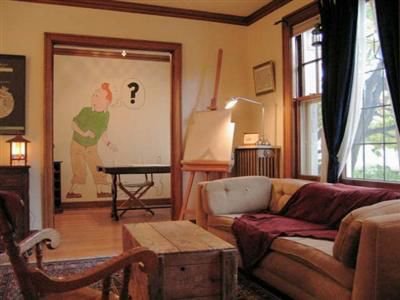
This is a just a short post to memorialize the place we have, last night, agreed to sell to someone else. Plenty of stuff could go wrong between now and the time it actually is to become that unmet person's property, but last night was the occasion upon which we agreed to terms, so I'm having my little moment now. It served both as my swank bachelor pad and also the first place L. and I lived after we were married. Plus, goddammit, it was a cool little crib. Quoting Ani DiFranco:
I'm recording our history now on the bedroom wall
and eventually the landlord will come
and paint over it all
Friday, November 11, 2005
On Audience, Redux
Someone walked by my office on Wednesday afternoon, reached down to give the dog, curled up in her usual place in the hallway just outside the door, a good scratch on the head, and asked if this was the famous brilliant yet neurotic dog, and oh, did we find a house yet? This is somebody known by me only to the eye--he works in another group on another floor, and I didn't know his name, nor had we ever had a conversation. He turned out, however, to be a manager on the Mechanical Turk project, and apparently one of the things you do if you're a manager on the Mechanical Turk project is search blogs to see what people are writing about your new product. So anyway, here was some fellow who'd figured out whom I was based on the fact that I worked peripherally on Mech Turk (which is what we cool "tech" people call it), and that I was the owner of a smart neurotic dog (who is, I might add, now utterly famous because what she does with her day is walk around the floor and wander into people's offices so that they can scratch her. Most people, apparently, have never met a dog this...personable). And, most importantly, he had read my blog.
Here in this ring of blogs we talk much meta- about what we are writing and for whom we write it, and I suppose some large portion of me hopes or imagines that I'm blogging to the masses, to people I don't know and who don't know me. A couple of weeks ago I blogged about Sam and U2 and acquired a comment from someone named Tarn, author of Matrices of Syncopation. She's at St. Mary's College, ergo a former collegue of Sam and Rebecca, and it turns out that she found me and had blogged about my blog a couple of months back (although she makes reference to me being funny, and what with our forays into intense Capitalism dragging me into glumness, I feel like I haven't written anything funny in awhile).
Anyway, it made me want more. You know, more audience. Audience is yummy. As I've said, almost the entire content of what I write is (un) secretly notes to L., or Sam & Red, or Greg, but every now and then I seem to be hitting something that worms its way into a slightly wider circle, and gives me that momentary glimpse of an idea that if I were writing slightly differently, I'd be...what? A rich and famous blogger? If I wrote about U2 or my insider view of the latest tech news all the time, I'm sure I'd find an immediate audience, but I think I'd find it pretty hard to tell my story within a context like that. And it's not at all clear what the story I'm trying to tell is, other than to write something that people want to read. Anyway, writing about U2 on the day or two after Sam and Tarn had had their transcendant experience at the D.C. show seems to me to be the closest I've come to what I'm trying to be get at. And it was kind of opportunist, and still a long way off.
By the way Mechanical Turk TPM Dude (and everyone else), we did get a house, we closed on Tuesday, I'm sitting in our new breakfast nook in our new kitchen using our new wireless broadband here at the end of a Friday night and thinking that, after all of that, it's a pretty fantastic thing.
Here in this ring of blogs we talk much meta- about what we are writing and for whom we write it, and I suppose some large portion of me hopes or imagines that I'm blogging to the masses, to people I don't know and who don't know me. A couple of weeks ago I blogged about Sam and U2 and acquired a comment from someone named Tarn, author of Matrices of Syncopation. She's at St. Mary's College, ergo a former collegue of Sam and Rebecca, and it turns out that she found me and had blogged about my blog a couple of months back (although she makes reference to me being funny, and what with our forays into intense Capitalism dragging me into glumness, I feel like I haven't written anything funny in awhile).
Anyway, it made me want more. You know, more audience. Audience is yummy. As I've said, almost the entire content of what I write is (un) secretly notes to L., or Sam & Red, or Greg, but every now and then I seem to be hitting something that worms its way into a slightly wider circle, and gives me that momentary glimpse of an idea that if I were writing slightly differently, I'd be...what? A rich and famous blogger? If I wrote about U2 or my insider view of the latest tech news all the time, I'm sure I'd find an immediate audience, but I think I'd find it pretty hard to tell my story within a context like that. And it's not at all clear what the story I'm trying to tell is, other than to write something that people want to read. Anyway, writing about U2 on the day or two after Sam and Tarn had had their transcendant experience at the D.C. show seems to me to be the closest I've come to what I'm trying to be get at. And it was kind of opportunist, and still a long way off.
By the way Mechanical Turk TPM Dude (and everyone else), we did get a house, we closed on Tuesday, I'm sitting in our new breakfast nook in our new kitchen using our new wireless broadband here at the end of a Friday night and thinking that, after all of that, it's a pretty fantastic thing.
Tuesday, November 08, 2005
This Sort Of Thing Is Not My Bag
I don't much post on politics these days because of its constant self-satirizing ridiculousness, but this is...really heavy with the irony.
Saturday, November 05, 2005
The Mechanical Turk
It's one a.m. on Friday night/Saturday morning, and I'm working. The reason this is happening is because a) I work on the internet, in all its 24-hour, global reaching glory, b) something is broken with said internet, and c) some of the people who work on part of this internet live in India, and this is the time during which both parties are awake.
The Mechanical Turk was a chess-playing automaton built by an 18th Century Hungarian. It was a box with a mannequin attached to it, with a chess board on top of the box. The box was visibly filled with gears and springs, and it seemed you could wind up the box, and the mannequin would play chess against any opponent, and almost always win.
Mechanical Turk is also the name of the project that's keeping me up late into the night tonight. It's an idea that sounds either very cool or completely useless, depending upon what kind of mood you're in. The idea is that humans are good at some tasks computers are not good at, such as recognizing if a photo contains a picture of a particular person, or writing an essay, or whatever. If you're writing a computer program, and you want to, e.g., evaluate a photostream, you'd like to be able to write something like this:
What you had to do previously is get a person to look at the photos and choose some. What Mechanical Turk lets you do is...get a person to look at the photos and choose some. You pay them three cents or so for doing it, and the Mechanical Turk website runs the process in between somebody looking at the photos and turning that into information you can aquire from a computer program, plus the administrivia of getting people paid (and taking a cut) and making sure workers are doing a reasonable job. It's banking on the idea that there are enough people in the world with nothing better to do so as to make this massive, constant, virtual artificially intelligent workforce. And that there is going to be some useful application out there in the world for this.
Amazon has become large enough to throw money at things like this, things which are functionally R&D products brought to the market just to see what happens. I gather that basically Jeff Bezos thought it was a cool idea. It might turn in to something, or it might die a swift death after creating a bunch of wonk-fueled buzz this week. What it makes me think of, sitting on the couch with a computer on my lap and a hands-free device in my ear, listening to people on two continents discuss a problem with the website that I already know we're not going to be able to solve tonight, is that no matter how automated a process seems to be, how mechanized the job that's being performed, there are always humans hidden away, deciding how the pieces will be moved. The secret of the original Mechanical Turk was a chess master concealed in the mannequin--the gears were just there for misdirection. Tonight I'm feeling like a lot of these things that look like the work of machines aren't really that much more automated--human intervention is still required. The only thing that has ever changed is how many levels deep it's hidden.
The Mechanical Turk was a chess-playing automaton built by an 18th Century Hungarian. It was a box with a mannequin attached to it, with a chess board on top of the box. The box was visibly filled with gears and springs, and it seemed you could wind up the box, and the mannequin would play chess against any opponent, and almost always win.
Mechanical Turk is also the name of the project that's keeping me up late into the night tonight. It's an idea that sounds either very cool or completely useless, depending upon what kind of mood you're in. The idea is that humans are good at some tasks computers are not good at, such as recognizing if a photo contains a picture of a particular person, or writing an essay, or whatever. If you're writing a computer program, and you want to, e.g., evaluate a photostream, you'd like to be able to write something like this:
  /* publish only photos that contain
      that God of Rock and Roll, The Edge
   */
  foreach p (photostream) {
    if (doesPhotoContainTheEdge(p)) {
       publishPhoto(p);
    }
  }
What you had to do previously is get a person to look at the photos and choose some. What Mechanical Turk lets you do is...get a person to look at the photos and choose some. You pay them three cents or so for doing it, and the Mechanical Turk website runs the process in between somebody looking at the photos and turning that into information you can aquire from a computer program, plus the administrivia of getting people paid (and taking a cut) and making sure workers are doing a reasonable job. It's banking on the idea that there are enough people in the world with nothing better to do so as to make this massive, constant, virtual artificially intelligent workforce. And that there is going to be some useful application out there in the world for this.
Amazon has become large enough to throw money at things like this, things which are functionally R&D products brought to the market just to see what happens. I gather that basically Jeff Bezos thought it was a cool idea. It might turn in to something, or it might die a swift death after creating a bunch of wonk-fueled buzz this week. What it makes me think of, sitting on the couch with a computer on my lap and a hands-free device in my ear, listening to people on two continents discuss a problem with the website that I already know we're not going to be able to solve tonight, is that no matter how automated a process seems to be, how mechanized the job that's being performed, there are always humans hidden away, deciding how the pieces will be moved. The secret of the original Mechanical Turk was a chess master concealed in the mannequin--the gears were just there for misdirection. Tonight I'm feeling like a lot of these things that look like the work of machines aren't really that much more automated--human intervention is still required. The only thing that has ever changed is how many levels deep it's hidden.
Wednesday, November 02, 2005
There Was Nothing About It That Didn't Suck
I've been thinking all day about what I wanted to write about the process of buying a house and selling our condo, and while it's not even remotely over, I'm logging in at this point in the perhaps vain hope that it gets better from here (please knock wood when you read this). But I can't think of a more cogent summary than what titles this entry. It long ago stopped being about the amount of money things cost, or the complete arbitrariness of the market. It's become instead this misery of having relationships with people grounded in the conscience of money, and being in this place where you're not supposed to take it personally.
The last time I came upon this, I boldly proclaimed that the problem was Capitalism itself and that it all had to end. That was a fun thing to say at the time, but surprise, the simple weapon that will allow a member of the unwashed masses to take down a fully armored multi-national corporation from 100 yards away hasn't yet occurred to me. Yet I still really want to know what the answer to this is--how do you return some humanity to this system which governs all of these basic human interactions? Getting a loan, being hurried through signing form after form with only a dim idea of what we were signing, making offers on houses, changing our minds about making offers on houses, firing our real-estate agent because of our discomfort with him on that same human level--because I couldn't not take them personally, all of these things made me feel like I was A Bad Person. And I'm pretty sure I'm not.
The last time I came upon this, I boldly proclaimed that the problem was Capitalism itself and that it all had to end. That was a fun thing to say at the time, but surprise, the simple weapon that will allow a member of the unwashed masses to take down a fully armored multi-national corporation from 100 yards away hasn't yet occurred to me. Yet I still really want to know what the answer to this is--how do you return some humanity to this system which governs all of these basic human interactions? Getting a loan, being hurried through signing form after form with only a dim idea of what we were signing, making offers on houses, changing our minds about making offers on houses, firing our real-estate agent because of our discomfort with him on that same human level--because I couldn't not take them personally, all of these things made me feel like I was A Bad Person. And I'm pretty sure I'm not.
A Shout-Out to My Peeps
An article on one of our favorite topics, the ill use of the word literally.
We used to joke about how one day, the dictionary entry for this word would look something like this:
It turns out it's almost already happened.
We used to joke about how one day, the dictionary entry for this word would look something like this:
- literally lit·er·al·ly adv.: figuratively.
It turns out it's almost already happened.
Tuesday, October 25, 2005
Gaining My Religion
Though I'm never one to pass up another occasion to laugh at Sam, his post-U2 concert fervor reminds me of something I've wanted to blog about for awhile: the religious experience. What is it? And how much does it actually have to do with religion?
It is the considered opinion of Thea, my erstwhile acupuncturist, mentor, and friend, that U2 are in fact exactly what Sam claims--not just a band, but a conduit to a preternaturally transcendant experience (this is doubly notable because Thea is not at all the kind of person you think of when you think, "U2 fan." Then, neither is Sam). No qualifiers or hedging needed: Bono is transmitting the universe, or god, or whatever your favorite word is, from a form that you cannot comprehend or experience into a form that you can. If that's not a religious experience, nothing is.
I think, moreover, that you're having this kind of experience, to a greater or lesser extent, every time you get lost reading a good book, watching film or t.v., or pretty much any time you "lose yourself." That's supposed to be what religious enlightenment feels like, isn't it--the loss of ego to some sense of ecstasy, no self consciousness, just joy? Having the ability to take someone out of themselves with narrative or art is a shamanic skill--most people I know simply couldn't invoke the kind of energy, e.g., to fill an amphitheater no matter how many lights, sound effects, tv screens, microphones, and guitar effects you gave them.
L. said that she never understood Catholicism as a religion until she stepped into a church in Rome. Seeing the art and the sculpture and the gold leaf and the stained glass, she realized what it must have been like hundreds of years ago when life was constantly cramped, dark, and smelly, and then one day you walked into one of these enormous, ornate, echoing light-filled temples. You really would experience god.
For me there's a certain pattern to it. As L. also noted a long time ago, experiencing really good narrative is a lot like falling in love. While you're in it, you just want more, because it's pulling you along, telling you the answers you've always wanted to know to the questions you never knew you wanted to ask. You can't wait for the next episode, or chapter, or tomorrow, to arrive.
It is the considered opinion of Thea, my erstwhile acupuncturist, mentor, and friend, that U2 are in fact exactly what Sam claims--not just a band, but a conduit to a preternaturally transcendant experience (this is doubly notable because Thea is not at all the kind of person you think of when you think, "U2 fan." Then, neither is Sam). No qualifiers or hedging needed: Bono is transmitting the universe, or god, or whatever your favorite word is, from a form that you cannot comprehend or experience into a form that you can. If that's not a religious experience, nothing is.
I think, moreover, that you're having this kind of experience, to a greater or lesser extent, every time you get lost reading a good book, watching film or t.v., or pretty much any time you "lose yourself." That's supposed to be what religious enlightenment feels like, isn't it--the loss of ego to some sense of ecstasy, no self consciousness, just joy? Having the ability to take someone out of themselves with narrative or art is a shamanic skill--most people I know simply couldn't invoke the kind of energy, e.g., to fill an amphitheater no matter how many lights, sound effects, tv screens, microphones, and guitar effects you gave them.
L. said that she never understood Catholicism as a religion until she stepped into a church in Rome. Seeing the art and the sculpture and the gold leaf and the stained glass, she realized what it must have been like hundreds of years ago when life was constantly cramped, dark, and smelly, and then one day you walked into one of these enormous, ornate, echoing light-filled temples. You really would experience god.
For me there's a certain pattern to it. As L. also noted a long time ago, experiencing really good narrative is a lot like falling in love. While you're in it, you just want more, because it's pulling you along, telling you the answers you've always wanted to know to the questions you never knew you wanted to ask. You can't wait for the next episode, or chapter, or tomorrow, to arrive.
Slow News Day
Here's our deep thought from Sunday brunch: one learns in 5th grade that the image of the outside world that ones brain receives from the optic nerve is inverted. The light that comes from the plane above eye level passes through the lens and is reflected onto the bottom of the optic nerve, and the light that comes from the below that plane is reflected onto the top. The reason we know it's not the optic nerve or its connectors that switch bottom to top is illustrated by the film I saw in the same 5th grade science cycle. They took a guy and put this apparatus over his eyes that switched the image he saw with a couple of mirrors--what was being fed to his eyes was already upside down. He wore the device continuously, and a week or two later, his brain adjusted and he started seeing right side up again. They showed him riding a motorcycle to prove that he could see okay. Question: Did his brain just undo the flip that it normally does, or did it flip the image again? Is there any physiological difference between these two things? Sub-question: Why hasn't someone released all of those fifth grade science films from the 1950's on DVD? First, they rocked. Second, it would prove that I wasn't crazy, since nobody seems to have seen this particular film except me.
Anyway, this all struck my ten-year-old brain as impossible. On the one hand, the dude could ride a motorcycle, and that's pretty compelling evidence. On the other hand, it seemed to ten-year-old me that you see from your eyes, not your brain. I didn't even buy that the image from my eyes was somehow upside down in the first place. I mean, I was looking right at it. I could see that it wasn't upside down.
So here's the deep thought. If your brain does something as dramatic as invert the image your eyes receive before you actually "see" it, what the hell else is it doing? What's being received that you don't see? What's not being received that you do?
(Editor's Note: this post markedly more interesting if you are stoned.)
Anyway, this all struck my ten-year-old brain as impossible. On the one hand, the dude could ride a motorcycle, and that's pretty compelling evidence. On the other hand, it seemed to ten-year-old me that you see from your eyes, not your brain. I didn't even buy that the image from my eyes was somehow upside down in the first place. I mean, I was looking right at it. I could see that it wasn't upside down.
So here's the deep thought. If your brain does something as dramatic as invert the image your eyes receive before you actually "see" it, what the hell else is it doing? What's being received that you don't see? What's not being received that you do?
(Editor's Note: this post markedly more interesting if you are stoned.)
Monday, October 24, 2005
TheOddsAreOneInSix
From a paper on Pride and Prejudice, written by a college student, somewhere in America:
"This shows that, though the marriage between Elizabeth and Darcy is the ideal match, it only happens one sixth of the time."
(Yes, he or she counted the number of marriages that take place in the novel).
I just love that on so many levels.
"This shows that, though the marriage between Elizabeth and Darcy is the ideal match, it only happens one sixth of the time."
(Yes, he or she counted the number of marriages that take place in the novel).
I just love that on so many levels.
Sunday, October 23, 2005
One Blog A Second
...it's a stat in the Harper's Index™ this month: "Average number of new blogs created each second: 1." Which just goes to show you (and by "you", I mean "me"), you're not nearly as unique as you thought. For those of you playing along at home that's 3600 blogs an hour, 86,400 blogs a day, 604,800 blogs a week, 31,536,000 blogs a year. A large percentage of these must be these bot-created spam blogs that seem to exist only to create Google hits (which, frankly, I can't figure out--it seems like the easiest thing in the world for search engines to weed out. Clearly I'm missing something). Another large percentage has got to be people who say to themselves, "hey, I'll start a blog, that'll be keen," write one entry, and never come back to it. But even if only one out of every ten blogs is actually somebody writing his or her (or its) thoughts on any sort of regular basis...well, you do the math.
I talked before about how, given a large demographic sample, you can make acurate behavioral predictions that are impossible to make about an individual in that group. I started a blog for a reason that, I imagine, is relatively atypical (though given 31 MILLION blogs a year, if only one in a thousand blogs are started as a project for school, I've got a lot of company anyway). After I'd been doing it for a month or two, I discovered a bunch of my friends were also blogging, and I sort of joined their club, and modified the things I blogged about, and so on. In other words, from the perspective of my little brain, the reasons I write a blog are rather nuanced and complex and seemingly unique. From the perspective of, e.g., the dude who compiles Harper's Index™, the fact that I write a blog is neither remarkable nor particularly surprising.
All this is by way of making an "it's a map, not the territory," argument. I can predict, for instance, that if you're reading this right now that you either, a) own an iPod, or b) are married to me. Well, I'm right, aren't I? And yet it's a strangely unimpressive inference. It's factually true, yet says almost nothing about the incredibly complex process that went into you deciding to (circle one) buy an iPod/marry me (if you're reading this blog and you neither own an iPod nor are married to me, well, who the heck are you? Leave me a comment or something). The model of the universe in which you are merely the sum of your decisions and actions, in which you are an actor in some mass market or abstracted closed system, is a useful model for making generalized predictions about the behavior of you and others who are in some way, "like" you. And it's a model that says nothing about how you, blog reader and iPod owner/spouse, got where you are, where you're going, or what's going on in your little brain right now.
Harper's Index™ is a registered trademark. Oh yes it is.
I talked before about how, given a large demographic sample, you can make acurate behavioral predictions that are impossible to make about an individual in that group. I started a blog for a reason that, I imagine, is relatively atypical (though given 31 MILLION blogs a year, if only one in a thousand blogs are started as a project for school, I've got a lot of company anyway). After I'd been doing it for a month or two, I discovered a bunch of my friends were also blogging, and I sort of joined their club, and modified the things I blogged about, and so on. In other words, from the perspective of my little brain, the reasons I write a blog are rather nuanced and complex and seemingly unique. From the perspective of, e.g., the dude who compiles Harper's Index™, the fact that I write a blog is neither remarkable nor particularly surprising.
All this is by way of making an "it's a map, not the territory," argument. I can predict, for instance, that if you're reading this right now that you either, a) own an iPod, or b) are married to me. Well, I'm right, aren't I? And yet it's a strangely unimpressive inference. It's factually true, yet says almost nothing about the incredibly complex process that went into you deciding to (circle one) buy an iPod/marry me (if you're reading this blog and you neither own an iPod nor are married to me, well, who the heck are you? Leave me a comment or something). The model of the universe in which you are merely the sum of your decisions and actions, in which you are an actor in some mass market or abstracted closed system, is a useful model for making generalized predictions about the behavior of you and others who are in some way, "like" you. And it's a model that says nothing about how you, blog reader and iPod owner/spouse, got where you are, where you're going, or what's going on in your little brain right now.
Harper's Index™ is a registered trademark. Oh yes it is.
Thursday, October 13, 2005
Slow Foods
Mark, of bachelor party fame, now reads this blog from time to time, so in the theme of writing letters to people via blogging, this missive is about something he brought up the other night. He and Adrienne just returned from their honeymoon in Italy last Friday. That is to say that she returned last Friday. Mark lost his passport and had to wander the streets of Milan, and then Copenhagen, for two days while waiting for a replacement passport (nobody who knows Mark is remotely surprised by this story. Such things are part of Mark's Essential Nature. Mark has fully accepted this part of his essence; when it pops up, he nods to it by saying, "Don't worry, baby. You're on the Cooper Train." Being on the Cooper Train means that something is about to go very, very not-as-planned).
They had us over on Tuesday for a post-wedding fiesta, during which we did absolutely nothing for four hours but cook and then sit around and eat. It was a four course meal wherein each courses had multiple sub-courses, and between each course were small breaks wherein we stopped to prepare the next thing we were going to eat, and also did some digesting. During the course (ha!) of all this, Mark brought up the Slow Food Movement, whose stated goal is to preserve food and the culture that goes with eating from, well, modern life.
I try to avoid, on principal, diatribes about how modern life is bad, because it really, really isn't. Modern life is pretty freaking awesome--not for everyone, obviously, and it should not be inferred that I'm advocating complacency because things are okay for you in particular. I just think there aren't many major truths that can be divined from statements that start "'X' ain't as good as it used to be" (or, frankly, the contrapuntal, "The advent of 'Y', will surely foment a revolution that creates a new utopia for all Mankind!" That really hasn't been true of much since the printing press, and even then, it's not like it ended war or world hunger). (As to the invention of the internet, see: printing press, the). And, I don't think that the rather unhealthy relationship we (very broadly speaking) have with food these days, about which I'm going to talk briefly in the next paragraph without making any definitive argument on the subject, doesn't have as much to do with "modern life," whatever one takes that to mean, as we probably generally think it does.
Jesus H. Ted, I use a lot of words.
It's no particular secret we're obese as a population, and it's no particular secret that there seems to be a fair causal relationship between that and the fact that we eat processed foods in large quantities and in short amounts of time. I think another problem, as I've mentioned before, is how far removed we've become from the process of actually acquiring and preparing our food. The only next logical step is to remove us from the actual eating of it, and I offer this, a breakfast item they sell in the cafeteria at my work, as evidence that this particular inconvenience is being worked out as well. Again, I'm not arguing for the return of The Golden Age of Sustinance Farming here, I'm arguing that removing ourselves from the actual process of gathering, preparing, and eating your food is actually tangibly harming our health. I'm not saying you gotta go out and hunt the stuff (though bully for you if you do), but I do think you have to pay attention. And jeez, might as well enjoy it too, while you're at it.
They had us over on Tuesday for a post-wedding fiesta, during which we did absolutely nothing for four hours but cook and then sit around and eat. It was a four course meal wherein each courses had multiple sub-courses, and between each course were small breaks wherein we stopped to prepare the next thing we were going to eat, and also did some digesting. During the course (ha!) of all this, Mark brought up the Slow Food Movement, whose stated goal is to preserve food and the culture that goes with eating from, well, modern life.
I try to avoid, on principal, diatribes about how modern life is bad, because it really, really isn't. Modern life is pretty freaking awesome--not for everyone, obviously, and it should not be inferred that I'm advocating complacency because things are okay for you in particular. I just think there aren't many major truths that can be divined from statements that start "'X' ain't as good as it used to be" (or, frankly, the contrapuntal, "The advent of 'Y', will surely foment a revolution that creates a new utopia for all Mankind!" That really hasn't been true of much since the printing press, and even then, it's not like it ended war or world hunger). (As to the invention of the internet, see: printing press, the). And, I don't think that the rather unhealthy relationship we (very broadly speaking) have with food these days, about which I'm going to talk briefly in the next paragraph without making any definitive argument on the subject, doesn't have as much to do with "modern life," whatever one takes that to mean, as we probably generally think it does.
Jesus H. Ted, I use a lot of words.
It's no particular secret we're obese as a population, and it's no particular secret that there seems to be a fair causal relationship between that and the fact that we eat processed foods in large quantities and in short amounts of time. I think another problem, as I've mentioned before, is how far removed we've become from the process of actually acquiring and preparing our food. The only next logical step is to remove us from the actual eating of it, and I offer this, a breakfast item they sell in the cafeteria at my work, as evidence that this particular inconvenience is being worked out as well. Again, I'm not arguing for the return of The Golden Age of Sustinance Farming here, I'm arguing that removing ourselves from the actual process of gathering, preparing, and eating your food is actually tangibly harming our health. I'm not saying you gotta go out and hunt the stuff (though bully for you if you do), but I do think you have to pay attention. And jeez, might as well enjoy it too, while you're at it.
Wednesday, October 12, 2005
Meta-Letter To Greg
Another reason I started this blog, besides the ostensible reasons, was to collect my thoughts on a particular subject. It's not clear what the particular subject is, something about why I'm pursuing a career in acupuncture and what I think it's all about, or whatever. One of the assigned texts for my first year in school was called Essential Spirituality, it's a 250-odd page book with a thesis that can be summarized thusly: Surveying the world's major religions (which the author selects for us, though no suprises amongst them either), one discovers they have some essential tenets in common. His argument is that you can infer from this how you should approach your spiritual life.
I thought that this book was highly dumb, because a) it should have been about ten pages long, and b) Okay, so one should chill out, treat everybody how one wants to be treated, and get rid of ones material attachments. Sattva enlightenment ensues. That's not so much the question. The question is how you do those things. It's not that this book is without advice on the subject, it's just that the advice looks like this:
Anyway, I thought: you know what, I could write this book. Only I could write it such that it was, a) actually useful, and b) entertaining enough that people would want to read it. I bring all of this up...(this sentence, or ones like it, now litering the discourse among the Three Weblogs of The Apocolypse)...because of Stonesthrow's last post about doing...stuff...with/in your life. I, too, tend to be an incredibly lazy ass, most of the time. Or that's my perception of myself, and probably everybody feels this way at least some of the time--the sensation that one should be doing 'x', but is not doing 'x', and instead playing solitare on the computer (or maybe that is just me).
One of the theses of this imaginary book I'm at least pretending to write is that I tend to think this phenomenon is some sort of a denial of ones true and essential self. If, for instance, you smoked and really, in the true and essential sense, wanted to quit, you would just do it. I don't mean to say that if you can't quit smoking you're weak-willed or nothing (there is that thing about nicotine being as physically addictive as heroin and all), more that your true and essential self really wants a goddamn cigarette, and that's the thing that needs to be addressed (if I can get a functional way to help quit smoking, or turn off the tv and instead paint your house, based on this idea, then I'll really have something). Greg pretty much sums this up, in the context of writing, when he says, "...I decided that I was just a procrastinating writer, and to suck up and deal, (but) I am perhaps too willingly accepting this."
I've thought about writing some sort of long narrative (many people are just referring to this concept as a 'book' these days) for years, basically since college, and every time I sat down to try it, I found I just couldn't make myself write. I thought for a long time I didn't like writing, but in fact I like writing a lot--e.g. I used to write letters with an obsessive focus. On the other hand, it turns out that I like blogging, it seems to be something I want to do, so I've tricked myself into writing this way. Or, in the above-described model, I've discovered a particular thing about my essential writing-self and I'm trying to work with it.
One can make onesself do things one doesn't really want to do. Sometimes one has to do this, but on the other hand, it sure isn't fun, and one surely is miserable while it's going on. So you: want to quit smoking/can't get yourself to write/don't want to paint the house/get off your ass and make the world a better place/etc. That seems to be step one. Step two is recognizing that an essential part of yourself needs nicotine or doesn't like painting or whatever. It's not that I don't believe in laziness, I believe that laziness is a symptom of trying to make onesself do something one doesn't want to do, or doing it in a way that one doesn't want to do it. I don't have step three formulated yet. I'm working on it though, because goddammit Greg, you've got to quit smoking.
I thought that this book was highly dumb, because a) it should have been about ten pages long, and b) Okay, so one should chill out, treat everybody how one wants to be treated, and get rid of ones material attachments. Sattva enlightenment ensues. That's not so much the question. The question is how you do those things. It's not that this book is without advice on the subject, it's just that the advice looks like this:
Relax. Take deep breaths. Meditate. Empty your mind. Focus on loving kindness for all living things.*
*Offer valid only if you are upper middle class, pretty much don't do anything with your day, and don't have to spend time worrying about anything, such as money, food, a daily commute, buying or selling anything, politics, the environment, religious fundamentalism, the state of the world in general, or coming into contact with anyone who might, say, not want to focus on loving kindness for some reason. Offer not valid in territories, protectorates, the Continental U.S., Europe, Capitalist Nations, Socialist Nations, Communist Nations, or countries or collectives bound by laws or communal social contracts of any kind. Do not taunt Happy Fun Ball. Attempting to achieve inner peace may cause passers-by to gawk and small children to poke at you with sticks. In the vast wide history of time, enlightenment has only been achieved by a couple of people sitting under trees three thousand years ago and some dude the Romans ended up nailing to a cross, so good luck with that.
Anyway, I thought: you know what, I could write this book. Only I could write it such that it was, a) actually useful, and b) entertaining enough that people would want to read it. I bring all of this up...(this sentence, or ones like it, now litering the discourse among the Three Weblogs of The Apocolypse)...because of Stonesthrow's last post about doing...stuff...with/in your life. I, too, tend to be an incredibly lazy ass, most of the time. Or that's my perception of myself, and probably everybody feels this way at least some of the time--the sensation that one should be doing 'x', but is not doing 'x', and instead playing solitare on the computer (or maybe that is just me).
One of the theses of this imaginary book I'm at least pretending to write is that I tend to think this phenomenon is some sort of a denial of ones true and essential self. If, for instance, you smoked and really, in the true and essential sense, wanted to quit, you would just do it. I don't mean to say that if you can't quit smoking you're weak-willed or nothing (there is that thing about nicotine being as physically addictive as heroin and all), more that your true and essential self really wants a goddamn cigarette, and that's the thing that needs to be addressed (if I can get a functional way to help quit smoking, or turn off the tv and instead paint your house, based on this idea, then I'll really have something). Greg pretty much sums this up, in the context of writing, when he says, "...I decided that I was just a procrastinating writer, and to suck up and deal, (but) I am perhaps too willingly accepting this."
I've thought about writing some sort of long narrative (many people are just referring to this concept as a 'book' these days) for years, basically since college, and every time I sat down to try it, I found I just couldn't make myself write. I thought for a long time I didn't like writing, but in fact I like writing a lot--e.g. I used to write letters with an obsessive focus. On the other hand, it turns out that I like blogging, it seems to be something I want to do, so I've tricked myself into writing this way. Or, in the above-described model, I've discovered a particular thing about my essential writing-self and I'm trying to work with it.
One can make onesself do things one doesn't really want to do. Sometimes one has to do this, but on the other hand, it sure isn't fun, and one surely is miserable while it's going on. So you: want to quit smoking/can't get yourself to write/don't want to paint the house/get off your ass and make the world a better place/etc. That seems to be step one. Step two is recognizing that an essential part of yourself needs nicotine or doesn't like painting or whatever. It's not that I don't believe in laziness, I believe that laziness is a symptom of trying to make onesself do something one doesn't want to do, or doing it in a way that one doesn't want to do it. I don't have step three formulated yet. I'm working on it though, because goddammit Greg, you've got to quit smoking.
Monday, October 10, 2005
Take Your Dog To Work Day
The oft-referenced unnamed e-commerce giant for whom I work has a couple of odd holdovers from its days as a startup. One is that we all work on "door-desks", which are fashioned from a birchwood door you might buy at a hardware store, four two-by-twos, and some corner braces (and which, when our founder famously built them by hand when the business was headquartered in his garage, were surely cheaper that buying office supply desks. Now that we've got 50,000 of them, I imagine they aren't). Another is that they allow dogs in the main corporate offices, so on every floor of the Pacific Medical Building in Seattle, there are four or five dogs roaming the halls.
We are the proud owners of a very intelligent, very neurotic border collie (the fact that she knows the word "neurotic" about sums it up) named Calli, and until Friday, I'd never brought her in to work, reasoning that she doesn't play well with other dogs, and likes people a little bit too much (so much so that she'll readily jump up on somebody who appears like they might pay her some attention). Also, not everybody likes dogs, and even if it's already part of the corporate environment, you never want to add to the annoyance of someone who's already having to suffer the hostility of a dog-ridden place of employment.
Unfortunately, the "Not Everybody" who likes dogs has lately included the people who live in our building, who have started complaining to us that she's barking all the time when we're not there, and since we're never ever ever ever going to find a house, it seemed like a good idea not to anger them all. With me working and L. teaching full time, Calli was spending a lot of the weekday alone, so on Friday I brought her in to the office for the first time, with not a little trepidation that she might freak out in a new environment. She is, after all, almost completely neurotic.
I believe about dogs the same thing I believe about very small children, which is that they are pretty much reflections of the energy (substitute for "energy" your favorite word that encapsulates the concept I'm about to outline) that's in their environment, filtered through their own dogness, or small-child-ness (actually, I believe that about people, too, it's just that dogs and small children don't have spoken language, and that makes the phenomenon more interesting). (Okay, what am I saying, I believe this about everything, animate and not: a topic for a future post, no doubt). A barking dog is reflecting stress in its environment, a crying child reflecting sadness in his or hers. You could argue that the dog is barking because the dog is stressed, the child is crying because it is sad (or hungry, or whatever), but like the Buddhists and a fair share of philosophers, I argue that such an isolated self doesn't exist (or, I should say, this model is less illuminating), that there is no barrier that distinguishes between the self and the non-self, just one long slippery slope (again, post for another time). And it's funny, but I think being a dog owner is the thing that solidified this concept in my mind.
Calvino: Whoa! Hold on there. Are you about to make some point about how your dog is some essential and inextractable part of your own self?
The Stoat: Well, actually, this was supposed to be a post about how Calli came to work and was an incredibly good dog and everyone loved her. But it, like everything else that ever appears in this blog, has devolved into a mass of Existentia. Anyway, yes, I would make that point.
Calvino: This is your dog you're talking about, right? Your pet. The thing that obsessively fetches tennis balls and is terrified of bugs?
The Stoat: And spends hours lying on the floor, idly chewing on her own paws, yes. That dog.
Calvino: You are one weird dude. And I'm pretty sure "Existentia" isn't a word.
The Stoat: Whatever. Language doesn't work that way.
I don't know if I meant this entry to be a Chicken-Soup-For-The-Soul, Lessons-Our-Dogs-Teach-Us story (as reflected through the Odds Are One's metaphor for being, whatever that is), but I brought the dog in on Friday, she met the other dogs and the other people and settled right in. She curls up on the floor or wanders through the halls into other people's offices (so that they can pet her, natch)--a coworker said to me, "You should bring her into work every day, it's so relaxing to have a dog just walk into your office. You can pet her for five minutes and then go back to what you were doing." I felt like a proud parent.
We are the proud owners of a very intelligent, very neurotic border collie (the fact that she knows the word "neurotic" about sums it up) named Calli, and until Friday, I'd never brought her in to work, reasoning that she doesn't play well with other dogs, and likes people a little bit too much (so much so that she'll readily jump up on somebody who appears like they might pay her some attention). Also, not everybody likes dogs, and even if it's already part of the corporate environment, you never want to add to the annoyance of someone who's already having to suffer the hostility of a dog-ridden place of employment.
Unfortunately, the "Not Everybody" who likes dogs has lately included the people who live in our building, who have started complaining to us that she's barking all the time when we're not there, and since we're never ever ever ever going to find a house, it seemed like a good idea not to anger them all. With me working and L. teaching full time, Calli was spending a lot of the weekday alone, so on Friday I brought her in to the office for the first time, with not a little trepidation that she might freak out in a new environment. She is, after all, almost completely neurotic.
I believe about dogs the same thing I believe about very small children, which is that they are pretty much reflections of the energy (substitute for "energy" your favorite word that encapsulates the concept I'm about to outline) that's in their environment, filtered through their own dogness, or small-child-ness (actually, I believe that about people, too, it's just that dogs and small children don't have spoken language, and that makes the phenomenon more interesting). (Okay, what am I saying, I believe this about everything, animate and not: a topic for a future post, no doubt). A barking dog is reflecting stress in its environment, a crying child reflecting sadness in his or hers. You could argue that the dog is barking because the dog is stressed, the child is crying because it is sad (or hungry, or whatever), but like the Buddhists and a fair share of philosophers, I argue that such an isolated self doesn't exist (or, I should say, this model is less illuminating), that there is no barrier that distinguishes between the self and the non-self, just one long slippery slope (again, post for another time). And it's funny, but I think being a dog owner is the thing that solidified this concept in my mind.
Calvino: Whoa! Hold on there. Are you about to make some point about how your dog is some essential and inextractable part of your own self?
The Stoat: Well, actually, this was supposed to be a post about how Calli came to work and was an incredibly good dog and everyone loved her. But it, like everything else that ever appears in this blog, has devolved into a mass of Existentia. Anyway, yes, I would make that point.
Calvino: This is your dog you're talking about, right? Your pet. The thing that obsessively fetches tennis balls and is terrified of bugs?
The Stoat: And spends hours lying on the floor, idly chewing on her own paws, yes. That dog.
Calvino: You are one weird dude. And I'm pretty sure "Existentia" isn't a word.
The Stoat: Whatever. Language doesn't work that way.
I don't know if I meant this entry to be a Chicken-Soup-For-The-Soul, Lessons-Our-Dogs-Teach-Us story (as reflected through the Odds Are One's metaphor for being, whatever that is), but I brought the dog in on Friday, she met the other dogs and the other people and settled right in. She curls up on the floor or wanders through the halls into other people's offices (so that they can pet her, natch)--a coworker said to me, "You should bring her into work every day, it's so relaxing to have a dog just walk into your office. You can pet her for five minutes and then go back to what you were doing." I felt like a proud parent.
Friday, September 30, 2005
Please Welcome As-Yet-Unnamed-Male Teter
As of 9:17 p.m. P.S.T., I'm an uncle. No great accomplishment on my part, I realize. On the other hand, you're going along in your life, doot dee doot dee doo, and stuff happens and, sure, you get married and whatever and that changes things a little, but you're still basically the same person you were when you were fifteen and whatever, and then all of sudden, BAM!, your sister has a baby, and all of a sudden your dad is Grandpa George and your mom is Grandma Linda and you're Uncle Paul. And you're like, holy crap, Uncle Paul is that guy who has been married to Aunt Paulette since before I can remember, that's not me, but the universe is like, no dude, that's totally you now, this is what happens in life, things change and it's totally freaky.
Anyway, welcome to the world, small child. Be well and do good, and try not to be freaked out about how your mom is actually my little sister.
Anyway, welcome to the world, small child. Be well and do good, and try not to be freaked out about how your mom is actually my little sister.
Subscribe to:
Comments (Atom)