If anyone out there is still paying attention, I decided not to renew my custom domain for this blog, because why would I do that? You may find all of your favorite Odds Are One content at the original blogger URL, http://theoddsareone.blogspot.com. As you were.
Friday, May 03, 2013
Saturday, December 22, 2012
On Sabbaticals
MTG and I were in the car this evening talking about something I would once normally have blogged about (the universe being a computer simulation in somebody else's universe--maybe I'll get to it sometime soon) and I remembered with fondness the act of blogging. Then I went and read some old comments and remembered the pleasure of the whole experience--the presence of a virtual intellectual community and the discussions that went on.
I may or may not be, at heart, an academic, but I came to a true love of ideas and of thinking them through and writing about them too late in life to really become one. It's not that I was too old to go (back) to graduate school, but that by then I had gotten used to, you know, not starving or living in a crappy apartment with a bunch of other starving academics, and finally not having the best-case-scenario result of my life pursuit be a series of one year posts at the University of Northwest Indiana at Gary. So, in any case, I never became one and it went onto the list of things that I did as a hobbyist while I made a living at my day job. As, it happens, almost all of us almost always do.
One of the ways my life has, however, been like an academic's is that I've been lucky enough to have sabbaticals. I took about six months off working in my early-mid 20's and another few months at age 29, and now another one again here ten years later, which has so far lasted nearly a year. In the first one I didn't accomplish a whole huge ton. I learned to program in PERL, which now that I think of it might be the single most profitable skill I have ever acquired (I'd listen to arguments about my math degree also, but following this thread will take me too far down the rabbit hole. I frequently feel a sort of kinship with David Foster Wallace--I think of things while writing about other things and then I want to write about those things before getting back to the thing I was writing about originally. Besides, it turned out my original point was invalid anyway. First sabbatical: highly successful). I could make similar arguments about the second, I guess: I made an album and in so doing learned how to make one in the modern way that one does, and that skill has followed me around since.
This third one has been really, really great. It has reminded me of a thing I know when I'm on sabbatical but forget when I'm done--one is on sabbatical not to refresh or recharge in order to go back and continue to do what one was doing. One leaves to do or create something new such that oneself is changed. One never returns from sabbatical. Whatever one returns to is something new. The one who returns is someone new.
I may or may not be, at heart, an academic, but I came to a true love of ideas and of thinking them through and writing about them too late in life to really become one. It's not that I was too old to go (back) to graduate school, but that by then I had gotten used to, you know, not starving or living in a crappy apartment with a bunch of other starving academics, and finally not having the best-case-scenario result of my life pursuit be a series of one year posts at the University of Northwest Indiana at Gary. So, in any case, I never became one and it went onto the list of things that I did as a hobbyist while I made a living at my day job. As, it happens, almost all of us almost always do.
One of the ways my life has, however, been like an academic's is that I've been lucky enough to have sabbaticals. I took about six months off working in my early-mid 20's and another few months at age 29, and now another one again here ten years later, which has so far lasted nearly a year. In the first one I didn't accomplish a whole huge ton. I learned to program in PERL, which now that I think of it might be the single most profitable skill I have ever acquired (I'd listen to arguments about my math degree also, but following this thread will take me too far down the rabbit hole. I frequently feel a sort of kinship with David Foster Wallace--I think of things while writing about other things and then I want to write about those things before getting back to the thing I was writing about originally. Besides, it turned out my original point was invalid anyway. First sabbatical: highly successful). I could make similar arguments about the second, I guess: I made an album and in so doing learned how to make one in the modern way that one does, and that skill has followed me around since.
This third one has been really, really great. It has reminded me of a thing I know when I'm on sabbatical but forget when I'm done--one is on sabbatical not to refresh or recharge in order to go back and continue to do what one was doing. One leaves to do or create something new such that oneself is changed. One never returns from sabbatical. Whatever one returns to is something new. The one who returns is someone new.
Saturday, July 03, 2010
Lies, Gender, and Damned Statistics
On Slashdot recently I encountered another version of Martin Gardner's two-children puzzle. The original problem is this:
The correct answer, if you've never encountered it, is based on the following a priori: there are four equally-likely ways to have two children:
Mrs. Transient Gadfly will tell you that Mr. Transient Gadfly's position on all questions of this nature is that it is not a math question, it is a language question. And, moreover, it is an ill-posed one. The nature of how poorly this question is posed is laid bare by the variation linked above:
(Here is one of those moments where Transient Gadfly has an existential crisis about the nature and purpose of The Odds Are One: should I explain why what I just said is true? It would take, like, seven paragraphs and still nobody reading would understand the logic. I'm not going to do it this time. You'll just have to take my word on this one).
If you're anyone else, you look at that question and understand the only way someone would pose the question: he or she randomly chose one of his or her children, and listed two characteristics of that child: his gender, and the day of the week of his birth. And you will come up with the correct answer to the question, because when you randomly chose one of your two children, the gender of the other one is a coin-flip. So, you might well ask, what is the difference between the original question posed by Martin Gardner and the question involving the day of the week? And the answer is, absolutely nothing. There is no way to tell, from the way it is stated, whether the asker, a parent of exactly two children, randomly chose one of his progeny and told you his gender, or a parent of exactly two children, of whom at least one is a boy, told you that fact. And it matters, because in the former case it's a 50% shot that the other child is a boy, and in the latter it's a 33% chance.
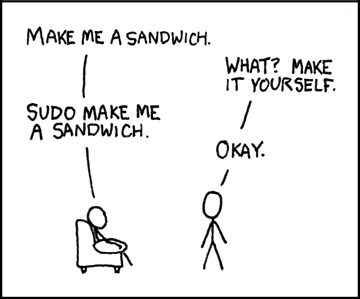
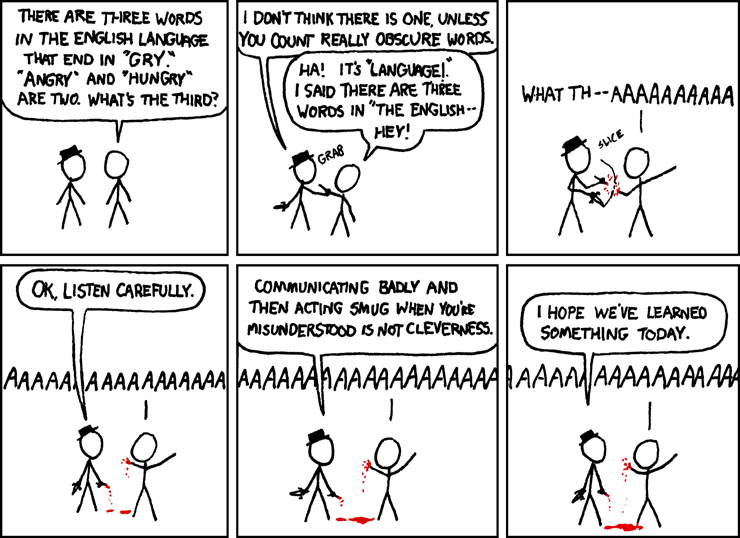
I leave you with a link to an XKCD cartoon, because it's literally impossible to make this point better than he has here.
I have two children. One of them is a boy. What are the odds the other one is also a boy?If you're a human living in the world, three things are probably true of you vis-a-vis this puzzle. 1) You've heard it before, 2) you got it wrong the first time you heard it, and 3) the correct answer still seems wrong to you.
The correct answer, if you've never encountered it, is based on the following a priori: there are four equally-likely ways to have two children:
- a boy followed by a girl
- a boy followed by another boy
- a girl followed by a boy
- a girl followed by another girl
Mrs. Transient Gadfly will tell you that Mr. Transient Gadfly's position on all questions of this nature is that it is not a math question, it is a language question. And, moreover, it is an ill-posed one. The nature of how poorly this question is posed is laid bare by the variation linked above:
"I have two children, one of whom is a boy born on a Tuesday. What's the probability that my other child is a boy?"If you follow the logic of the original problem (which, being that I am a human in whose true nature you will find the compunction to write this blog, I did) you'll write out all the days of the week your first child could be born, followed by all the days of the week your second child could be born, look at all of those that have a boy born on a Tuesday in them, count the number of those that have a second boy, and come up with the answer (it's 13 in 27, if you write out the table. Do not write out the table). If you are literally anyone else in the world, you will come up with a much better answer: 1 in 2. The crux of the issue, which the linked article almost hits on but then fails to, is that there is no universe in which the given answer (13 in 27) is correct. It would require the asker of the question to randomly chose a day of the week and a gender, and then only pose the question if he or she had a child that matched those criteria.
(Here is one of those moments where Transient Gadfly has an existential crisis about the nature and purpose of The Odds Are One: should I explain why what I just said is true? It would take, like, seven paragraphs and still nobody reading would understand the logic. I'm not going to do it this time. You'll just have to take my word on this one).
If you're anyone else, you look at that question and understand the only way someone would pose the question: he or she randomly chose one of his or her children, and listed two characteristics of that child: his gender, and the day of the week of his birth. And you will come up with the correct answer to the question, because when you randomly chose one of your two children, the gender of the other one is a coin-flip. So, you might well ask, what is the difference between the original question posed by Martin Gardner and the question involving the day of the week? And the answer is, absolutely nothing. There is no way to tell, from the way it is stated, whether the asker, a parent of exactly two children, randomly chose one of his progeny and told you his gender, or a parent of exactly two children, of whom at least one is a boy, told you that fact. And it matters, because in the former case it's a 50% shot that the other child is a boy, and in the latter it's a 33% chance.
I leave you with a link to an XKCD cartoon, because it's literally impossible to make this point better than he has here.
Tuesday, June 01, 2010
New Releases
Two new releases for your Tuesday:
- A new five song e.p. from The Calculus Affair. It's available for free download from http://tinyurl.com/5songs-tca (this link expires in two weeks, so if for some reason you're reading this after the 14th of June and you want a copy, leave me a comment or something). It's culled from my 2010 RPM Challenge album, and it's a little bit on the weird side for The Calculus Affair. But it's still pretty good.
- My nephew, Alex Dean Trendler, arrived this morning at 6:12 a.m. MDT. 6 lbs. 1 oz., 21 1/2 inches. A big fan of The Calculus Affair, no doubt.
Wednesday, April 28, 2010
And The Worst Part Is, I Never Learned How To Read
I just got my first pair of reading glasses. My left eye doesn't quite make it around to the thing I'm focusing on, which causes me to work harder to make a reasonable stereo image of something close to my face (this condition has a name, but I can't remember what it was). I've apparently been compensating for this problem without really knowing I had it. At the beginning of my last visit my optometrist did a couple of checks and then asked: Do you find it difficult to focus, or that sometimes you see a double image when you read? Do you get tired while reading? Yep. All my life. I'd never really noticed the first thing until Mrs. Transient Gadfly pointed out that I close one eye when reading in bed, which was apparently my main compensation mechanism (it works only passingly well, as I fall asleep almost comically fast while reading anyway).
So now I have glasses with a slight prism in the left lens (the other option was 12 weeks of vision therapy, which I'll probably try some day when I don't have an 18-month-old). The other thing my optometrist mentioned, almost in passing, was that this would help my reading comprehension. As long as it has mattered (a little bit in high school, mostly in college), I've known that I don't absorb anything by reading it. I can follow a narrative, but my reading comprehension is for crap. I have adapted to this fine in life; on the verbal portion of standardized tests I read the questions before reading the paragraph; I figured out that I have to write down notes on the material if I want to know anything about it when I'm done.
Are these two things related? I haven't had the glasses long enough to know if they're going to help me glean new meaning from the text. But I'd always assumed that my brain just wasn't wired to learn by reading, never once thinking that it might be because my eyes were draining all my battery power just trying to stay focused on the words in front of them.
So now I have glasses with a slight prism in the left lens (the other option was 12 weeks of vision therapy, which I'll probably try some day when I don't have an 18-month-old). The other thing my optometrist mentioned, almost in passing, was that this would help my reading comprehension. As long as it has mattered (a little bit in high school, mostly in college), I've known that I don't absorb anything by reading it. I can follow a narrative, but my reading comprehension is for crap. I have adapted to this fine in life; on the verbal portion of standardized tests I read the questions before reading the paragraph; I figured out that I have to write down notes on the material if I want to know anything about it when I'm done.
Are these two things related? I haven't had the glasses long enough to know if they're going to help me glean new meaning from the text. But I'd always assumed that my brain just wasn't wired to learn by reading, never once thinking that it might be because my eyes were draining all my battery power just trying to stay focused on the words in front of them.
Saturday, December 19, 2009
Okay, fine
Everybody's doing a Songs of the Aughts. Following Fronesis' lead, and observing the same rules, here are selections out of my music player at work that were released this decade and made it into my favorites playlist (notes as appropriate):
- "Clouds" - The Long Winters (Putting The Days to Bed - 2006)
- "Carousel" - Iron & Wine (The Shepherd's Dog - 2007)
This whole album is great--it's got a very post-CSNY vibe to it. This song, like the Fleet Foxes entry below, makes me forget what I was doing and start staring out the window when it comes on. - "Where I Am" - Westerly (Wild Wild Wind E.P. - 2007)
Mrs Transient Gadfly found these guys playing at our Farmers Market one Sunday and bought this five song E.P. They've since released two more albums and seem to be touring around the country these days. This is still their best work. - "Joe Metro" - Blue Scholars (Bayani - 2007)
Just your average major-label released rhyme about riding the bus down the Rainier Valley. Words do not describe how awesome this song is. - "Overkill (Acoustic)" - Colin Hay (Man @ Work - 2003)
- "Start a War" - The National (Boxer - 2007)
- "Your Name" - Kevin Hyatt/Gino Scarpino (Badly Bare Demos - 2008)
A collaborative effort by two friends of mine. I find this song to be highly compelling, it's a rhythmic acoustic folk song with an organic mellotron and a funky 808 beat. - "Knife" - Grizzly Bear (Yellow House - 2006)
- "Flicks" - Frou Frou (Details - 2002)
- "Little Round Mirrors" - Harvey Danger (Little By Little - 2005)
"A shooting star is/a little piece of/cosmic debris desperately wanting to fall to the Earth/It doesn't get too far/(it's not a real star)/it's hardly worth the footnotes in your memoir." - "Blue Ridge Mountains" - Fleet Foxes (Fleet Foxes - 2008)
- "On a Different Shelf" - Jim Noir (Jim Noir - 2008)
- "Spacewater" - Dzihan and Kamien (Freaks and Icons - 2000)
This electronica album has never been my favorite album at any one time, but it's been at the top of the list for ten years now. - "People Are Like Suns" - Crowded House (Time on Earth - 2007)
Is this entire album about the death of Paul Hester, or is that just me? - "Greyboy" - Soul Patch (Sooner or Later - 2007)
- "You Can Have It All" - Yo La Tengo (And Then Nothing Turned Itself Inside Out - 2000)
Yo La Tengo is a (relatively) new discovery for me. I listen to this album and wonder how they aren't more famous than they are. - "Paper Tiger" - Beck (Sea Change - 2002)
I've never liked Beck all that much, but this is a great, stripped down album. - "Such Great Heights" - The Postal Service (Give Up - 2003)
I'm pretty sure this one's on everybody's list everywhere. There's a band called "Owl Town" that had the number one song on the Billboard charts a couple of weeks ago. I listened to it. It was the Postal Service, except about half as good musically and not even in the same universe lyrically. Man, Ben Gibbard...that guy is a genius. - "Carry Me Ohio" - Sun Kil Moon (Ghosts of the Great Highway - 2003)
2005's Tiny Cities, which is a collection of covers of Modest Mouse songs, is also utterly worth your time. - "Slipping Through the Sensors" - Fruit Bats (Mouthfuls - 2003)
- "A Fond Farewell" - Elliott Smith (From a Basement on the Hill - 2004)
This album is hard to listen to. It's unfinished and it's pretty raw and Elliott Smith was in a lot of pain. And of course it has moments of transcendence, too. - "Heartbeats" - Jose Gonzales (Veneer - 2005)
That song from that commercial with the colorful bouncing balls. His cover of Massive Attack's "Teardrop" from 2007 would also make this list if I didn't have that one artist rule. - "Casimir Pulaski Day" - Sufjan Stevens (Come On Feel the Illinoise - 2005)
One of the best albums of the decade. - "Que Sera" - Wax Taylor (Tales of the Forgotten Melodies - 2005)
French cinemaphile electronica. - "Your Hand In Mine" - Explosions in the Sky (The Earth Is Not A Cold Dead Place - 2003)
Apparently Explosions in the Sky does not do the theme from Friday Night Lights. How this is possible I do not know. - "Your Girlfriend's Car" - Throw Me The Statue (Moonbeams - 2008)
I again tout the awesomeness of Throw Me The Statue. They are awesome. - "Daily Mutilation" - Jon Auer (Beautiful Escape: Songs of the Posies Revisited - 2008)
Here is the coolest I have ever been: Mrs. Transient Gadfly and I were at the Posies show that doubled as the release party for this album, and after it was over we went down to the merchandise table to say goodnight to the guy who owns the record label, and he gave me a gig poster that he was having all the artists on the record sign for his collection. I was signing it as Jon Auer walked up. I handed him the pen and the poster and he looked at me as if he should know who I was. - "Turn and Run" - Neil Finn (One Nil - 2001)
Well, obviously.
Monday, November 30, 2009
Causal Loop
And now, with no fanfare or reintroduction, The Odds Are One resumes its original charter of blogging about Odds-Are-One-y things. For at least this one post. Maybe.
I read about a thought experiment with pool tables and time travel in an article in Slate a couple of months ago (several other interesting ideas about the current thinking on time travel in there as well--for instance, they've pretty much dismissed the idea of multiple futures branching off which we here at the Odds Are One had figured out years ago, and they seem to think that time travel requires an entry and an exit portal--kind of like a tunnel--such that people from the future can't come back to tell us about the invention of time travel until somebody invents a time machine for them to come back in. So that explains why we don't see those time travelers from the future wandering around. I guess). The idea behind this experiment seems to me to throw a wrench in our thinking about free will, which is always fun to contemplate.
Imagine a pool table with a little time-traveling tunnel on it. You shoot ball into one end of the tunnel, and it goes back in time one second and comes out the other end. So you see your pool ball roll out of the far end of the tunnel a second before you shoot it into the near end (if I had this setup I'd probably sit there for a while trying to fool the tunnel into making the pool ball roll out without actually rolling it in in the first place. That'd be awesome. Except that it wouldn't work, but whatever). Then you'd realize that if you lined up the two ends of the tunnel, you could make your shot interfere with itself: you could make it so that the ball would come out from the future right as your shot was going towards the entrance to the tunnel, knocking it out of the way so that it didn't enter the tunnel...so that it would never have gone back in time in the first place. You'll have created a physical paradox: if the ball goes in the tunnel, it would knock itself out of the way and never go into the tunnel. But if it doesn't go into the tunnel, then it wouldn't be there to knock itself out of the way, so it would roll into the tunnel. And so on.
Some people spent a lot of time thinking about this and figured out that what would happen is that you would always knock your ball askew such that it went into the tunnel at a different angle than you planned, making it come out of the tunnel in the past at a different angle than you planned, making it glance off its future self at a different angle than you planned, etc. etc. They further noted that this is a sort of simplified model of the Going-Back-In-Time-And-Killing-Your-Own-Grandfather paradox: the implication being that no matter how hard you tried to do it, you would fail. You'd go back in time and try and kill your Grandfather and someone would stop you, or it'd turn out your Grandmother had already conceived, or you'd kill somebody you thought was your Grandfather but it turned out there was a family scandal that you'd never heard about and that guy wasn't really your Grandfather. No matter what you did, the fact would remain that you had already been born, and you therefore couldn't prevent yourself from being born.
In this thought experiment there are clear limits on the exercise of your free will. Do what you like, but you will not kill your biological grandfather before your mother or father is conceived because it didn't happen that way. The same is true of the pool-table experiment: if you've got, say, a five minute tunnel loop set up, and you see a pool ball roll out of the from-the-future end of the tunnel, you now know that in five minutes you (or someone) is going to have to roll the ball into the other end of the tunnel, and no matter what you do in the intervening five minutes, that has to happen (I don't know about you, but that would creep me the hell out. Imagining a psychotic murderer entering the billiard room, killing me (with the lead pipe), and then becoming curious about what the tunnels on the pool table do and rolling a ball in, I'd stand there in a cold sweat looking over my shoulder for five minutes and then roll the ball into the tunnel). Anyway, two questions:
I read about a thought experiment with pool tables and time travel in an article in Slate a couple of months ago (several other interesting ideas about the current thinking on time travel in there as well--for instance, they've pretty much dismissed the idea of multiple futures branching off which we here at the Odds Are One had figured out years ago, and they seem to think that time travel requires an entry and an exit portal--kind of like a tunnel--such that people from the future can't come back to tell us about the invention of time travel until somebody invents a time machine for them to come back in. So that explains why we don't see those time travelers from the future wandering around. I guess). The idea behind this experiment seems to me to throw a wrench in our thinking about free will, which is always fun to contemplate.
Imagine a pool table with a little time-traveling tunnel on it. You shoot ball into one end of the tunnel, and it goes back in time one second and comes out the other end. So you see your pool ball roll out of the far end of the tunnel a second before you shoot it into the near end (if I had this setup I'd probably sit there for a while trying to fool the tunnel into making the pool ball roll out without actually rolling it in in the first place. That'd be awesome. Except that it wouldn't work, but whatever). Then you'd realize that if you lined up the two ends of the tunnel, you could make your shot interfere with itself: you could make it so that the ball would come out from the future right as your shot was going towards the entrance to the tunnel, knocking it out of the way so that it didn't enter the tunnel...so that it would never have gone back in time in the first place. You'll have created a physical paradox: if the ball goes in the tunnel, it would knock itself out of the way and never go into the tunnel. But if it doesn't go into the tunnel, then it wouldn't be there to knock itself out of the way, so it would roll into the tunnel. And so on.
Some people spent a lot of time thinking about this and figured out that what would happen is that you would always knock your ball askew such that it went into the tunnel at a different angle than you planned, making it come out of the tunnel in the past at a different angle than you planned, making it glance off its future self at a different angle than you planned, etc. etc. They further noted that this is a sort of simplified model of the Going-Back-In-Time-And-Killing-Your-Own-Grandfather paradox: the implication being that no matter how hard you tried to do it, you would fail. You'd go back in time and try and kill your Grandfather and someone would stop you, or it'd turn out your Grandmother had already conceived, or you'd kill somebody you thought was your Grandfather but it turned out there was a family scandal that you'd never heard about and that guy wasn't really your Grandfather. No matter what you did, the fact would remain that you had already been born, and you therefore couldn't prevent yourself from being born.
In this thought experiment there are clear limits on the exercise of your free will. Do what you like, but you will not kill your biological grandfather before your mother or father is conceived because it didn't happen that way. The same is true of the pool-table experiment: if you've got, say, a five minute tunnel loop set up, and you see a pool ball roll out of the from-the-future end of the tunnel, you now know that in five minutes you (or someone) is going to have to roll the ball into the other end of the tunnel, and no matter what you do in the intervening five minutes, that has to happen (I don't know about you, but that would creep me the hell out. Imagining a psychotic murderer entering the billiard room, killing me (with the lead pipe), and then becoming curious about what the tunnels on the pool table do and rolling a ball in, I'd stand there in a cold sweat looking over my shoulder for five minutes and then roll the ball into the tunnel). Anyway, two questions:
- can you construct a similar experiment that demonstrates such limits on the nature of free will that doesn't require time travel (I suspect, but can't yet prove, that you can)?
- can free will instead be salvaged by an advanced understanding of cause-and-effect? The Odds are One sides with the Buddhists on this (there's no such thing as cause-and-effect) but lacks a better model to explain pool balls from the future or, really, anything else.
Subscribe to:
Posts (Atom)